“Why Not Hockey?”: A Father’s Legacy and the Rise of a Quiet Revolution
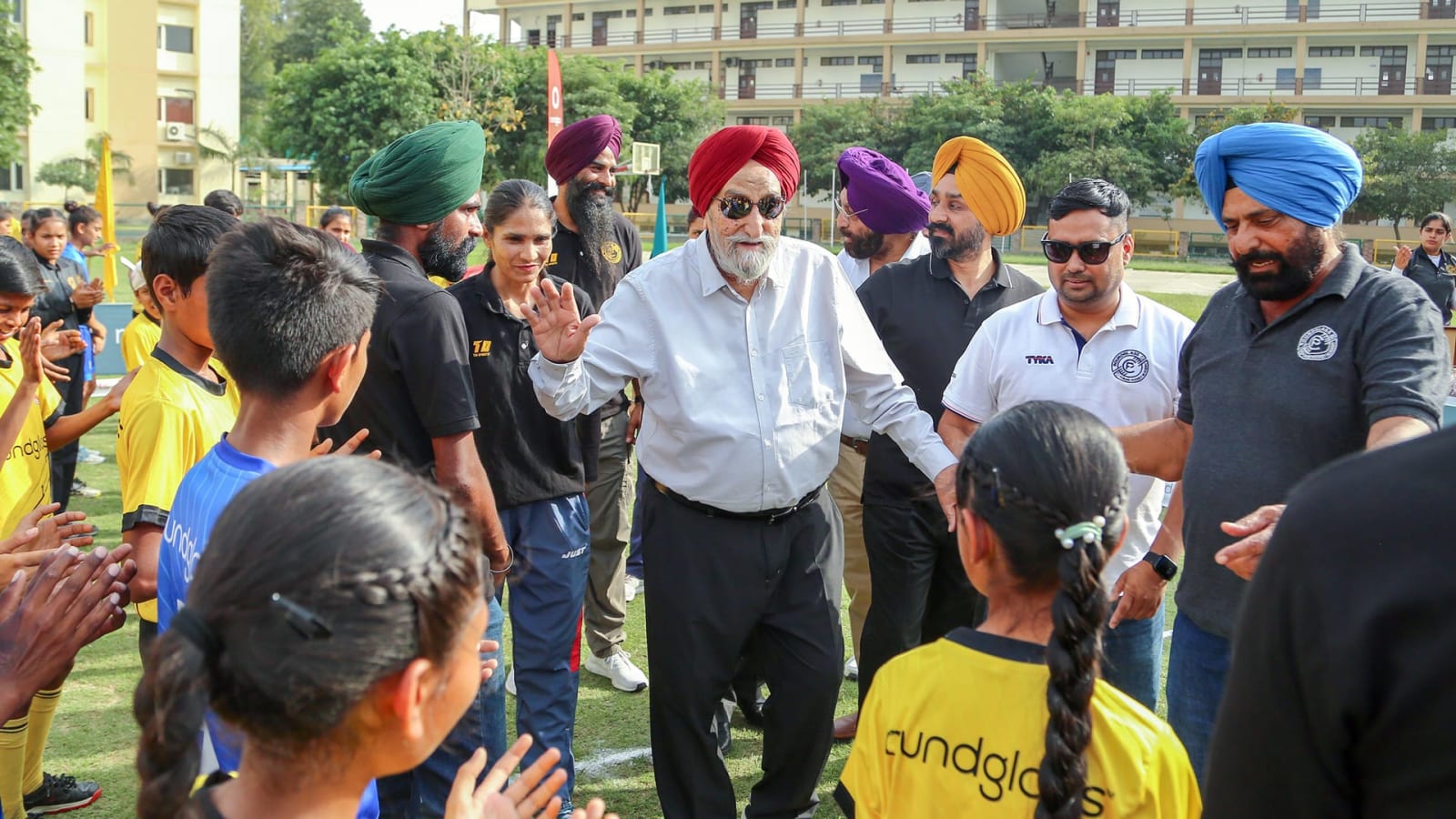
My father is 95 and still runs every conversation like a locker room. He loves to hold court, telling stories from the field, sharing lessons with the same sharpness that made generations of players sit up straighter. He talks easily about discipline, teamwork, and the joy of craft. But he never boasts about how relentless he once was. That part you discover between the lines.
He trained more than 15 Olympians over his life, helped Ghana build its first national hockey team back in the ’60s, and was honored with the Dronacharya Award for Lifetime Achievement by the Government of India in 2021. Yet you will not hear him recite any of this. He is far more interested in how a young player stands after a hard loss than in reminding anyone how far he climbed.
Even now, he calls Ashfaque, the team Hockey Lead, after every tournament. He wants the full download, asking, “Who showed character under pressure? Who cracked? Who might be quietly worth believing in again, even if no one else sees it yet?” His standards have not slipped an inch.
I see now that he was never just coaching hockey. He was building a system of belief. Ownership mattered more to him than talent. He could teach skill, but he could not manufacture hunger. So, he looked for it relentlessly. That is one of the quiet truths learned from him: If people do not feel they own the outcome, no amount of top-down investment can make them great.
When we started Roundglass Sports, my father was there from the very beginning, not just in spirit but in the way we structured everything. Sports had been his entire life, and he understood that the discipline and rigor it demands stay with you long after the final whistle. He was pleased to see me investing in sports, even if at first it was only football that captured my full attention.
Then one day, almost under his breath, he asked a question that carried far more weight than it seemed.
“Why not hockey?”
It was part lament, part spark.
Hockey was once India’s pride, even if never officially named our national sport. For decades it was our signature on the world stage, with eight Olympic golds between 1928 and 1980 that made every Indian stand taller. But after the 1970s, the game began to slip from view. The shift from grass to Astroturf put us at a technical and financial disadvantage, while richer nations modernized quickly. Around the same time, cricket rose to capture our collective imagination, drawing crowds, media, and money away from older fields. My father watched it all unfold. I could tell it cut deeper than he ever admitted. Not because it shrank his own legacy, but because it robbed young people of a proving ground that had once shaped our character as a nation.
I heard my father’s whisper. I set aside a little for hockey, mostly to honor him. It was never meant to be the centerpiece of the company. We poured our real investments into football. We hired international coaches, built sophisticated facilities, mapped out strategic blueprints. For hockey we invested only a patch of grass, a few sticks—it hardly had a budget. We did literally just enough to say we had not forgotten.
But here is where belief works differently from plans.
This small, nearly overlooked program started to take on a life of its own. My father’s old protégés stepped in as coaches. They carried forward his fierce insistence that character comes before everything. Players from small villages started showing up. They did not wait for a manual. They built a culture for themselves, one that held each other accountable, one where nobody coasted and everyone knew they belonged to something larger.
Ownership did what money could not. These young athletes felt it was their team. That is why they pushed themselves in ways no top-down system could demand.
Today, that modest hockey program is outperforming India’s best-funded academies. Our grassroots centers across Punjab have become known for beating far bigger setups. These kids are winning national tournaments, wearing India’s jersey, proving that values hold longer than budgets ever do.
One of our goalkeepers, Princedeep Singh, is a prime example. He joined us with raw passion and little else. Today, he’s guarding India’s net in the FIH Pro League and helped the junior team win gold at the Asia Cup.
Princedeep Singh didn’t come from a system that favored him. He came from one that could’ve forgotten him, if we hadn’t believed first.
And here’s what we’ve seen since:
Over 2,600 young athletes have trained at Roundglass Punjab Hockey Academy through 18 Development Centers and 30 Grassroots Centers across Punjab.
Our players have won every major hockey tournament in India in the past year alone, bringing home gold from the Hockey India Junior Men Championship, the Punjab Hockey League, and the All India Balwant Kapoor Tournament, among others.
And more important, they’re now representing India. Players like Gurjot Singh, Arshdeep Singh, Princedeep Singh, Gursewak Singh, Hardik Singh, and Dilpreet Singh have earned national team placements.
In fact, just last week, our Punjab Women’s team brought home silver from the first Hockey India Masters Cup in Chennai, losing by a single goal to Odisha. The men’s side reached the quarterfinals before being edged out by Tamil Nadu, who went on to win it all. The team walked off the field with their heads held high, knowing they had tested themselves against the best.
We never set out to build a hockey powerhouse. We simply planted strong values in good soil. The players and coaches did the rest. They took it as their own and pushed it further than any strategy could have planned.
Watching this keeps teaching me something deeper about legacy. It is not the structures you build, or the statues people put up for you. True legacy is how others carry your questions and standards forward, sometimes long after you stop steering it yourself. My father does not have to talk about how far he once pushed or how high he climbed. These players show it every time they step on the field.
He still calls for every detail. Still wants to know who needs an extra word, who might be worth watching next season. He still loves to stand in the circle and teach, even if that circle is now often online. But it is clear this story has already grown beyond him, beyond me, beyond any plan we ever wrote down.
I watch how he builds loyalty, and it is something I still aspire to replicate. He does what most leaders overlook. He never speaks to people by title or position. Whether it is a player, a junior coach, or someone on staff, he starts by understanding their life, their home, their hopes. He builds a bond first, a relationship that sees the entire human being, not just what they can produce on the field. That is how he creates trust that runs deeper than any contract. That is how you build from wholeness.
He has taught me that belief and care can outrun privilege. That structure, when rooted in trust, shapes character long before it shapes skill. That real excellence rarely announces itself through pedigree. It grows quietly, through young people who learn to belong to something bigger than themselves.
I used to think legacy was about what you construct, the visible structures that prove you did something worthwhile. Now I see it differently. Legacy lives in the standards you set that others choose to carry forward, long after you have stopped pushing.
It turns out punching above your weight is never about pretending to be more than you are. It is about refusing to believe you are too small to make a mark.
That is the quiet lesson my father keeps teaching. And perhaps the greatest truth of all is this: What begins as a tribute can end up becoming your most meaningful creation, simply because it was built on love, belief, and the audacity to trust that people will rise when you give them something worth rising for.
Lead From Wholeness.
This article is part of Sunny Singh's LinkedIn series on Wholistic Wellbeing.
About the Teacher
