India’s Voice, the World’s Future
Centuries of lived practice in coexistence, resilience, and renewal go unheard.
India is one of the oldest civilizations and the largest democracy on earth. Our diaspora is vast. Our economy is rising. Our thinkers lead in technology, medicine, arts, and law. Yet in too many places where decisions are made, in policy tables, academic debates, or media narratives, India’s perspective is simplified, filtered, or absent entirely.
Global presence alone is not enough. Voice is what changes outcomes. Without India’s voice, rooms risk repeating old mistakes while overlooking new possibilities. With India’s voice, global systems gain frames of reference rooted in pluralism, wellbeing, and dignity.
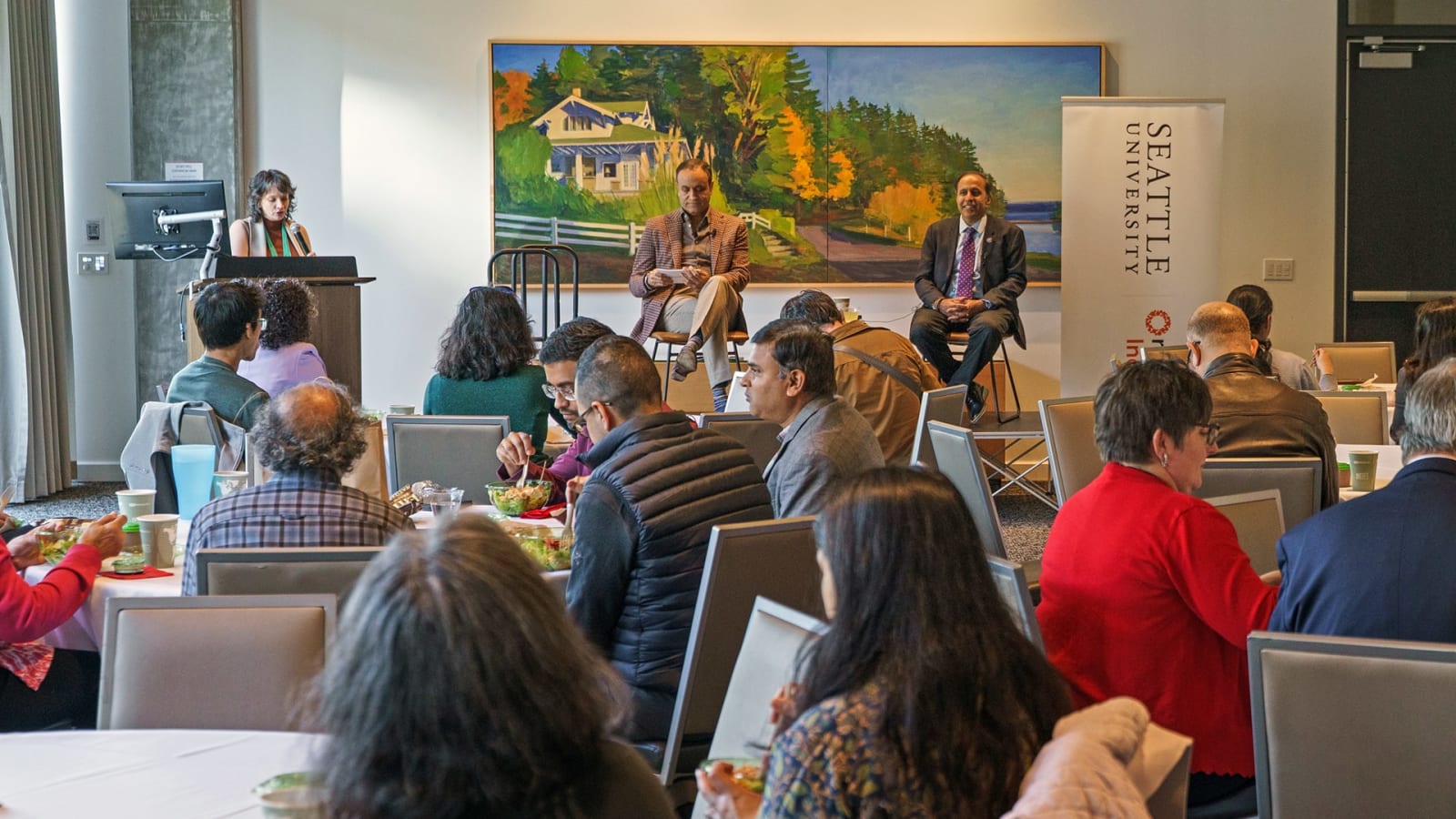
This is why I chose to fund the Roundglass India Center at Seattle University. My role is not to create another event series but to help usher its strategy so it becomes a permanent bridge: a home where Indian perspectives meet global debates with credibility and continuity. The enter nurtures a new generation of Indian voices across academia, diplomacy, innovation, and wellbeing, voices that are grounded in heritage and fluent in the future.
A Strategic Platform, Not Symbolism
The Roundglass India Center was founded on a simple but urgent idea: India must not wait to be invited into global conversations. It must claim its place as a contributor and convener.
The center was built to do three things:
- Educate with evidence.
- Connect India and the United States through real exchange.
- Give back through scholarships and justice projects.
Already, this vision is finding real expression. In early conversations with Professor Sital Kalantry, who now leads the Roundglass India Center, we shared the same frustration: India’s depth was missing from U.S. public life. That absence weakened policies, narrowed relationships, and erased opportunities. The center is designed to correct that gap by pairing Indian and American voices so that dialogue, not monologue, drives durable change.
The Diaspora as Operating Language
The Indian diaspora is the world’s largest, spanning continents and sectors. But scale is not the diaspora's only strength. What sets it apart is values. Across generations, Indian diaspora leaders have carried with them discipline, resilience, and a deep sense of responsibility to both their adopted countries and their ancestral home.
This dual belonging is not a liability. It is operating leverage. The diaspora can translate India’s lived wisdom into global frameworks for health, climate, technology, and justice. At the same time, the diaspora can bring global insights back home to strengthen institutions and opportunities in India.
Take Ashok Kumar, who grew up in rural Rajasthan. His parents once sold their truck to fund his education. A Roundglass scholarship brought him to Seattle University to study law. Today, he works in legal compliance and still pushes for access to justice in Punjab. He also bought that truck back for his family. Ashok is one example of what happens when new voices gain entry into global rooms. His lived perspective travels with him, and that presence strengthens every debate he joins.
Philanthropy, in this context, is not rescue. It is partnership. By investing in platforms like the Roundglass India Center, we create structures where lived perspectives from the diaspora are not just shared but applied, shaping policy, guiding institutions, and informing global decision-making.
Why This Moment Matters
The world is fractured. From a pandemic to climate change to AI governance, every global challenge now crosses borders. Designing responses without India’s voice, with its scale, its civilizational wisdom, and its democratic experience, is designing blind.
For India itself, the stakes are equally high. A young population, an entrepreneurial drive, and an economy poised for long-term growth mean that India is shaping not only its own future but also the world’s. If our voices remain sidelined, that future will be defined by others.
This is why the diaspora must step forward now. We need more leaders who see their careers not only as personal achievements but as contributions to a shared future. We need voices that can carry India’s frameworks of coexistence, resilience, and renewal into the rooms where global agendas are written.
A Call to Action
Leadership begins with wholeness and dignity while honoring roots while creating continuity into the future. The Roundglass India Center is one model of how this can be done. But no single institution is enough. The real potential lies in the Indian diaspora itself.
To every Indian abroad, I offer this provocation: Your presence is not the point. Your voice is. What structures are you helping build? What ideas are you carrying into the rooms you enter? What bridges will outlast you?
If we want a world that is more resilient, more plural, and more humane, India’s voice must be central. And it will take the Indian diaspora, its passion-driven individuals with integrity and work ethic, to ensure that voice is not just heard but heeded.
The elephant is already in the room. The question is no longer whether it is seen. The question is whether we will let it speak with clarity, courage, and consequence.
Lead From Wholeness.
This article is part of Sunny Singh's LinkedIn series on Wholistic Wellbeing.
About the Teacher
